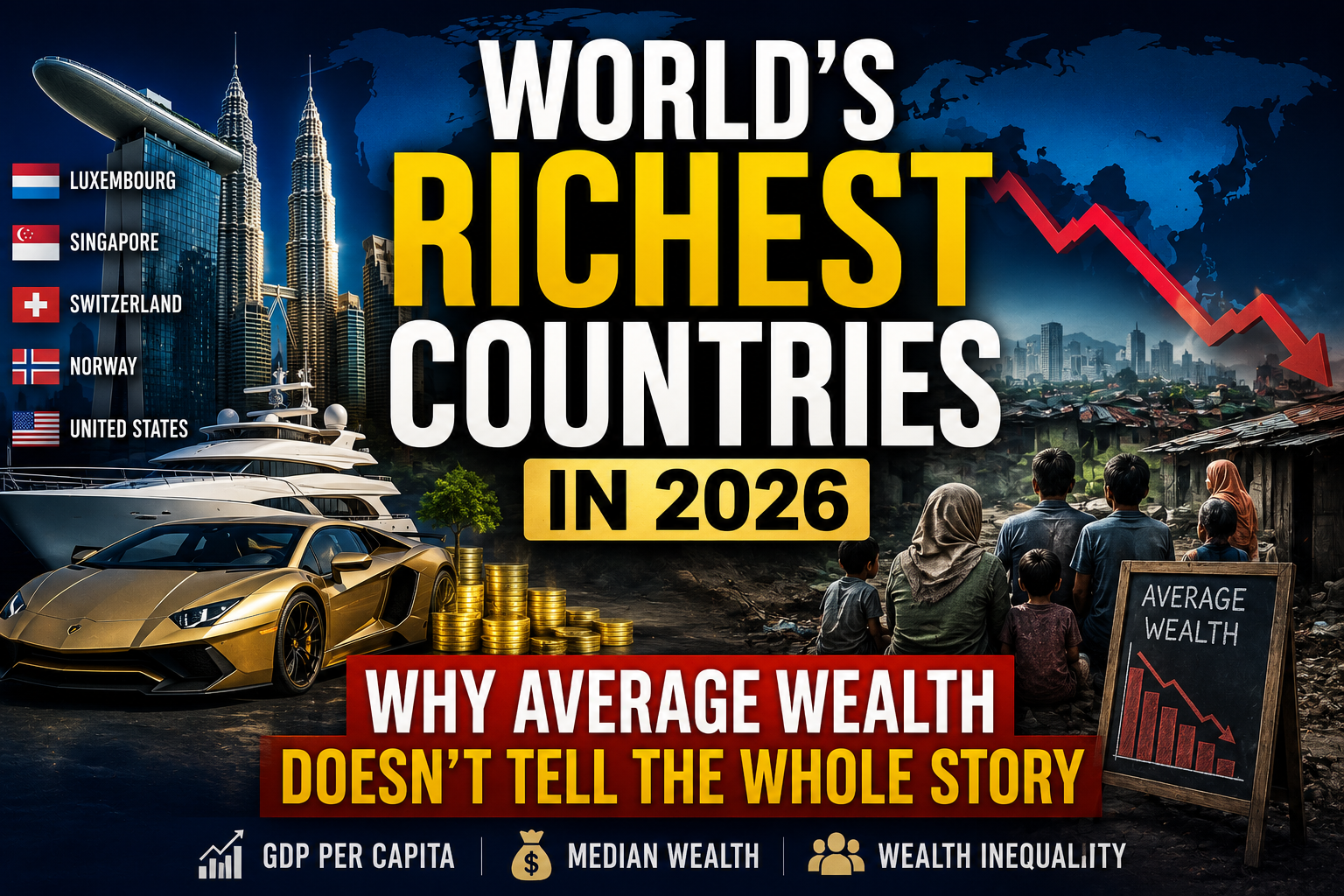
World’s Richest Countries in 2026:
Global Wealth Report Reveals a Different Picture of National Prosperity
When people think about the world’s richest countries, they often assume the answer depends on which nation has the largest economy or the highest number of billionaires. However, the latest Global Wealth Report 2026 shows that measuring wealth is far more complex than it appears. The report explains that a country’s ranking can change significantly depending on whether wealth is measured by average wealth per adult or median wealth.
These two methods provide different perspectives on financial prosperity. Average wealth highlights the total value of assets divided among adults, while median wealth reflects the financial position of the typical person in a country. Because of this difference, the list of the world’s richest nations can vary considerably.
Average Wealth and Median Wealth: What’s the Difference?
Average wealth is calculated by dividing a country’s total household wealth by its adult population. This figure can rise sharply if a relatively small number of people own extremely valuable assets. As a result, countries with many high-net-worth individuals often appear near the top of global rankings.
Median wealth, on the other hand, represents the middle point of wealth distribution. Half of the adult population owns more than the median amount, while the other half owns less. Economists often consider this measure a better indicator of how wealth is shared across society because it is less influenced by billionaires and ultra-rich households.
Switzerland Leads in Average Wealth
According to the report, Switzerland continues to rank among the wealthiest countries in the world when measured by average wealth per adult. The country’s strong financial sector, stable economy, and high-value assets contribute to its leading position.
The United States also remains near the top of the rankings due to its large economy, successful technology companies, and significant concentration of wealthy individuals. Luxembourg follows closely, benefiting from its role as an international financial center.
Other global financial hubs, including Singapore and Hong Kong, continue to perform strongly because of their investment sectors and high levels of private wealth.
Luxembourg Tops the Median Wealth Rankings
The rankings change noticeably when median wealth is used instead of average wealth.
Luxembourg moves to the top position, indicating that wealth is more broadly distributed among its residents. Belgium also performs exceptionally well, followed by countries such as Australia, New Zealand, and Denmark.
These countries demonstrate that strong household savings, widespread home ownership, and well-developed pension systems can improve the financial well-being of ordinary citizens, even if they have fewer billionaires than larger economies.
Why Wealth Distribution Matters
One of the report’s main conclusions is that wealth distribution is just as important as wealth creation. A country may have enormous national wealth, but if most of it is concentrated among a small group of individuals, average wealth alone can create a misleading picture.
Median wealth provides a better understanding of how financial resources are shared across society. It reflects whether the average family benefits from economic growth rather than measuring only the success of the wealthiest households.
Gulf Countries Continue to Build Wealth
The report also highlights the financial performance of Gulf economies. Qatar remains among the region’s wealthiest countries in terms of average wealth per adult, supported by its energy sector and high national income.
The United Arab Emirates also ranks strongly thanks to its diversified economy, international investment environment, and growing financial services industry.
However, when wealth is measured using the median approach, several European countries continue to outperform Gulf economies because wealth is spread more evenly among their populations.
Small Nations Deliver Strong Financial Security
An interesting finding is that several relatively small countries rank above much larger economies when median wealth is considered.
Nations such as Luxembourg, Belgium, Denmark, and New Zealand demonstrate that long-term financial stability, savings, pension systems, and property ownership play an important role in improving living standards for ordinary citizens.
Their success suggests that sustainable wealth is not determined solely by economic size but also by how effectively financial opportunities are shared across society.
What the Findings Mean
The Global Wealth Report 2026 encourages governments, economists, and investors to look beyond traditional economic indicators. Instead of focusing only on national income or total wealth, the report highlights the importance of understanding how wealth reaches households.
Countries that create opportunities for broader wealth ownership often achieve stronger long-term financial stability and better living standards.

Comments
Leave a Comment