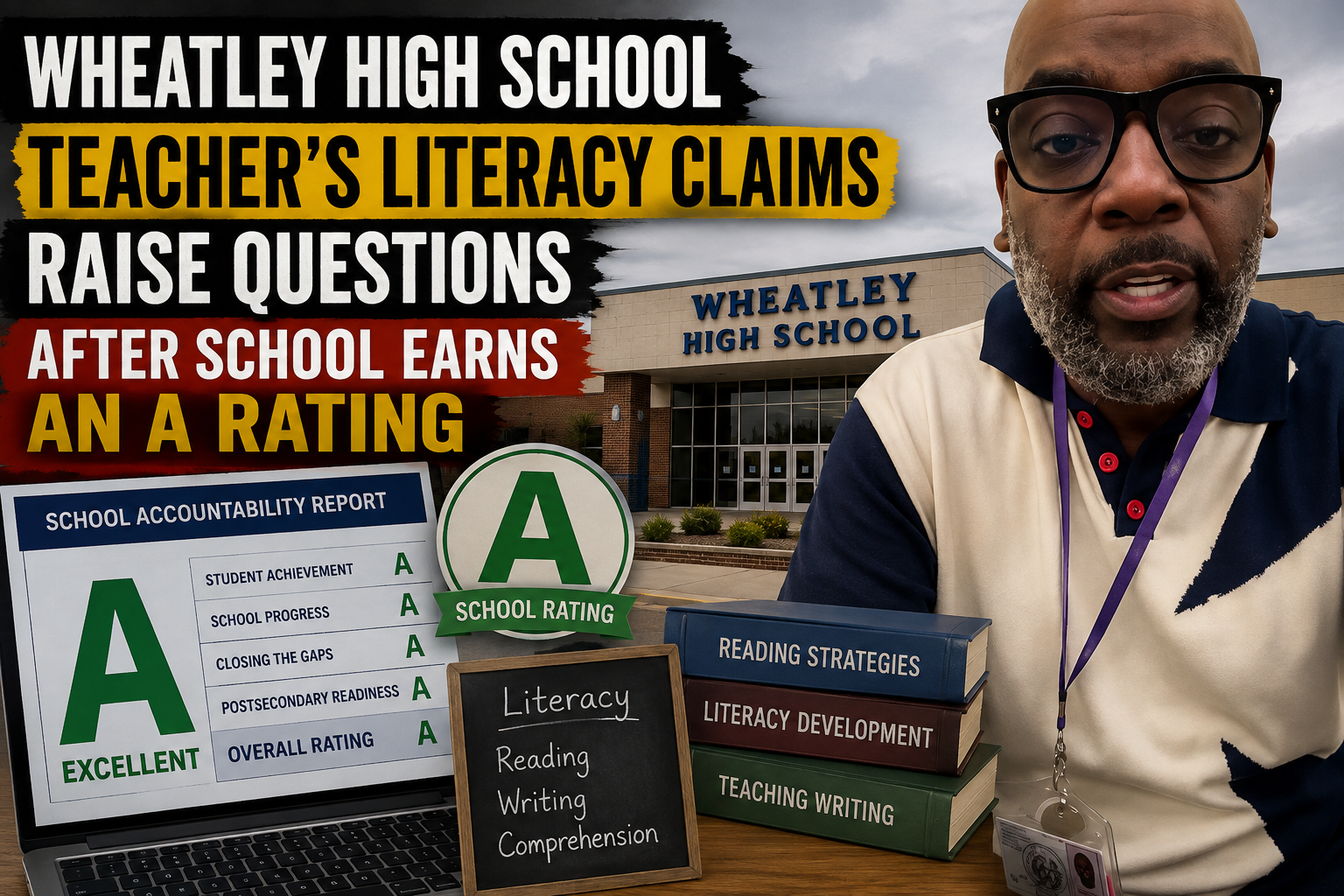
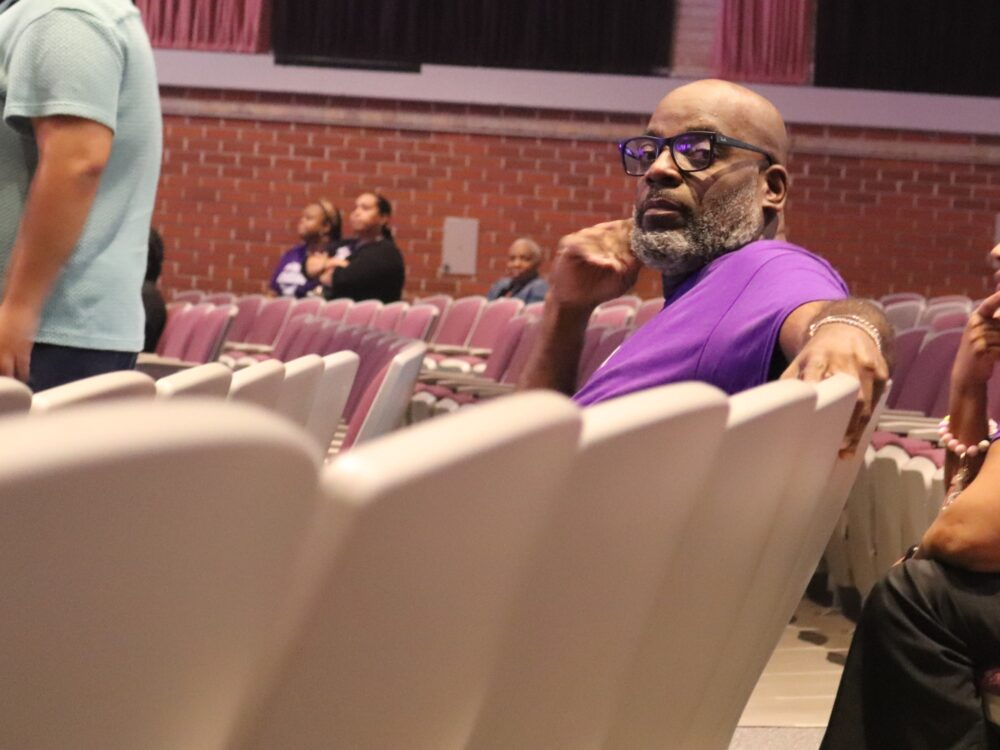
Wheatley High School in Houston has found itself at the center of a growing debate about student literacy, school accountability and the impact of education reforms after a teacher’s emotional social media video went viral.
The controversy began when Darius Williams, a career and technical education teacher at Wheatley High School, posted a video claiming that some of his senior students struggled significantly with reading and writing. The video quickly attracted millions of views and prompted widespread discussion about the academic condition of students at the school.
The situation became even more complicated when Wheatley High School celebrated an important milestone just days later: its first-ever A accountability rating from the Texas Education Agency.
The contrasting developments have raised questions about how a school can receive a top accountability rating while some teachers continue to report serious literacy challenges among individual students.
Teacher’s Viral Video Sparks Controversy
Darius Williams’ video gained widespread attention after he described his concerns about the reading and writing abilities of some students during the opening days of the school year.
In the emotional video, Williams said he had senior students who could not read and others who struggled to write. His comments quickly spread across social media, with the video reportedly receiving more than 4.9 million views.
The teacher’s emotional presentation appeared to draw significant public attention to an issue that has long been discussed in American education: whether standardized test results accurately reflect the academic abilities of every student in a school.
Williams’ comments also generated criticism from students and members of the community who felt that publicly discussing students’ academic weaknesses was inappropriate.
The controversy was therefore not limited to literacy itself. It also raised questions about professional conduct, student privacy and the responsibility educators have when discussing challenges inside their classrooms.
Wheatley Students Push Back Against the Claims
Students at Wheatley High School offered mixed perspectives about literacy abilities among their classmates.
Some students acknowledged that certain peers experience difficulties with reading or writing. However, several students strongly rejected the broad impression created by the viral video that Wheatley students generally cannot read or write.
Michael Jackson, a 17-year-old junior at the school, said that he could read and write but sometimes had difficulty with longer or more complicated vocabulary.
Jackson also criticized Williams for discussing the issue publicly on social media.
His comments reflected a broader concern among students that academic difficulties should be addressed through educational support rather than presented publicly in a way that could embarrass students or their families.
Students Describe a More Complicated Reality
The responses from Wheatley students suggest that literacy abilities may vary significantly from one student to another.
A student struggling with advanced vocabulary, reading comprehension or written expression is not necessarily unable to read or write. Similarly, the existence of students performing below grade level does not automatically mean that an entire school has failed academically.
This distinction is particularly important when interpreting claims made in viral social media posts, where complex educational issues can quickly be reduced to short statements that attract attention.
Wheatley High School Celebrates an A Rating
While the teacher’s video was circulating online, Wheatley High School received major positive news.
The campus celebrated its first A accountability rating from the Texas Education Agency.
The achievement represents a significant change for a school that has experienced years of academic difficulties and has been at the center of the Houston Independent School District’s state intervention.
Students arriving at the campus were greeted by a colorful sign celebrating the school’s new rating.
For school administrators and supporters of the district’s reforms, the A rating represents evidence that academic performance has improved.
However, the viral video has raised a different question: Can a school achieve strong accountability results while some students still struggle with fundamental academic skills?
https://www.instagram.com/reels/Db_qrt5xD5u
What the A Accountability Rating Represents
A school accountability rating is designed to provide an overall measurement of academic performance and progress.
Such ratings can incorporate multiple measures rather than evaluating every individual student’s reading and writing abilities.
As a result, a school can perform strongly under an accountability system even though individual students may continue to require additional support.
This distinction is important when examining Wheatley’s situation.
The A rating provides evidence of improvement under the state’s accountability framework, but it does not necessarily mean every student has reached the same academic level.
Individual Student Performance Can Differ
Schools are made up of students with different academic backgrounds, learning needs and educational experiences.
Even in schools with excellent overall performance, some students may struggle with:
- Reading comprehension
- Writing skills
- Vocabulary
- Mathematics
- Academic confidence
- Previous learning gaps
For this reason, an accountability rating and a teacher’s observation can potentially describe different parts of the same educational environment.
Superintendent Responds to the Teacher’s Claims
At a school board meeting, state-appointed Superintendent Mike Miles addressed the controversy surrounding Williams’ video.
Miles acknowledged that literacy and mathematics challenges among older students had existed at Wheatley before the current reforms.
He argued that the situation had been worse several years earlier, with more 11th- and 12th-grade students reportedly performing below grade level in reading and mathematics.
His comments placed the teacher’s allegations within the broader history of Wheatley High School and HISD.
Rather than presenting the situation as a new problem, Miles described it as an issue that the district had been working to address over several years.
Wheatley’s Long History of Academic Struggles
The controversy cannot be separated from Wheatley High School’s history.
The campus experienced years of poor academic performance before the state intervened in Houston ISD.
In 2019, Wheatley received its seventh consecutive F rating under the Texas accountability system.
The consecutive failing ratings became a major factor in the eventual state takeover of the district.
Texas did not issue school or district accountability ratings in 2020 and 2021 because of the COVID-19 pandemic.
When ratings returned in 2022, Wheatley received a C.
The school then received a D rating in 2023 before improving to a B in 2024.
The progression from repeated F ratings to C, D, B and eventually A represents a substantial change in the school’s accountability results.
The 2023 State Takeover of Houston ISD
The situation at Wheatley is also connected to the larger state takeover of Houston Independent School District.
In 2023, Texas education authorities took control of the district following years of concerns about academic performance at certain campuses.
Mike Miles was appointed to lead the district as part of the intervention.
Wheatley became one of the campuses operating under changes associated with Miles’ approach to school improvement.
The state takeover has remained controversial, with supporters arguing that significant changes were necessary to improve academic outcomes, while critics have questioned the methods used and the impact on teachers, students and communities.
New Education System Brings Major Changes
Wheatley High School is among the HISD campuses participating in Mike Miles’ New Education System model.
The model has emphasized structured instruction, standardized approaches and greater consistency in classroom teaching.
Supporters argue that the system can create stronger academic expectations and improve student outcomes.
Critics, however, have raised concerns about its rigid instructional style and the pressure placed on educators.
The debate surrounding Wheatley now provides another example of the broader disagreement over how educational improvement should be measured.
Improved Test Scores Versus Classroom Challenges
One of the central questions raised by the controversy is whether standardized accountability results tell the complete story of student achievement.
A school can improve its test scores and accountability rating while still having students who need significant academic intervention.
This is not necessarily a contradiction.
Large schools serve hundreds of students, and their abilities can vary widely. Schoolwide performance measures provide an overall picture, while teachers see individual students and their specific needs every day.
The challenge for education leaders is to address both levels of performance.
Strong schoolwide results should be celebrated, but individual students who are struggling should not be overlooked.
Why Literacy Remains a Major Education Issue
Reading and writing are foundational academic skills. Students who enter their final years of high school without strong literacy abilities can face serious challenges in college, vocational education and the workforce.
Literacy affects much more than English classes.
Students need to understand written instructions, complete applications, read technical information, communicate effectively and understand increasingly complex material as they progress through education and employment.
For that reason, concerns about senior students struggling with reading or writing deserve serious attention even when a school is showing measurable improvement.
Supporting Students With Learning Gaps
Schools can use several strategies to help students who are behind academically.
These can include:
- Targeted literacy intervention
- Small-group instruction
- Individual academic assessments
- Reading comprehension programs
- Writing support
- Vocabulary development
- Additional tutoring
- Teacher collaboration
- Regular progress monitoring
Identifying students who need assistance is only the first step. Schools must also provide consistent resources and support to help those students improve.
The Debate Over Educator Social Media Use
The Wheatley controversy also highlights the growing influence of social media in education.
Teachers have access to platforms that can reach millions of people within hours. A classroom concern that might once have been discussed privately can now become a national conversation almost instantly.
This creates both opportunities and risks.
Social media can help educators draw attention to important problems, but public statements about students can also create concerns about privacy, dignity and professional responsibility.
The reaction from Wheatley students demonstrates why educators must carefully consider how their comments may affect the young people they teach.
A School’s Progress Can Still Include Unfinished Work
Wheatley’s A rating is an important milestone in the school’s academic history.
The progression from repeated F ratings to an A suggests that measurable improvements have occurred under the current education system.
At the same time, the teacher’s claims and students’ responses show that school improvement is not necessarily complete simply because an accountability rating has improved.
Education is a long-term process.
A school can make significant progress while still having students who need additional support. Recognizing those remaining challenges does not necessarily erase the achievements represented by an improved rating.
Instead, both realities can exist at the same time.
What the Wheatley Controversy Means for Houston Schools
The debate at Wheatley High School extends beyond one teacher or one campus.
It reflects a larger national discussion about how schools should measure success.
Should schools primarily be judged by standardized test results? Should teacher observations receive greater consideration? How should schools address students who remain behind despite overall improvement?
There are no simple answers.
Accountability systems can provide valuable information about academic progress, but individual student experiences are also important.
The most effective education policies need to consider both measurable outcomes and the real challenges students and teachers encounter inside classrooms.
Conclusion
The controversy surrounding Wheatley High School began with a teacher’s viral claims that some senior students struggled to read and write. His emotional social media video attracted millions of views and generated criticism from students who felt that the comments unfairly embarrassed the school community.
Only days later, Wheatley celebrated its first A accountability rating from the Texas Education Agency, creating a striking contrast between the teacher’s concerns and the school’s measurable academic progress.
Wheatley’s history provides important context. The school previously experienced years of poor ratings, including seven consecutive F ratings before the state’s intervention in Houston ISD. Since then, its rating improved from C in 2022 to D in 2023, B in 2024 and eventually A.
The latest developments suggest that school improvement can be complicated. A strong accountability rating can demonstrate meaningful progress while individual students may still face serious academic challenges.
Ultimately, the most important question is not simply whether Wheatley High School has improved. It is whether that improvement is reaching every student and whether students who continue to struggle are receiving the support they need to succeed.
The debate surrounding Wheatley is therefore likely to continue, not only as a discussion about one school’s A rating, but as part of a much larger conversation about literacy, accountability, education reform and how America measures success in its classrooms.

Comments
Leave a Comment