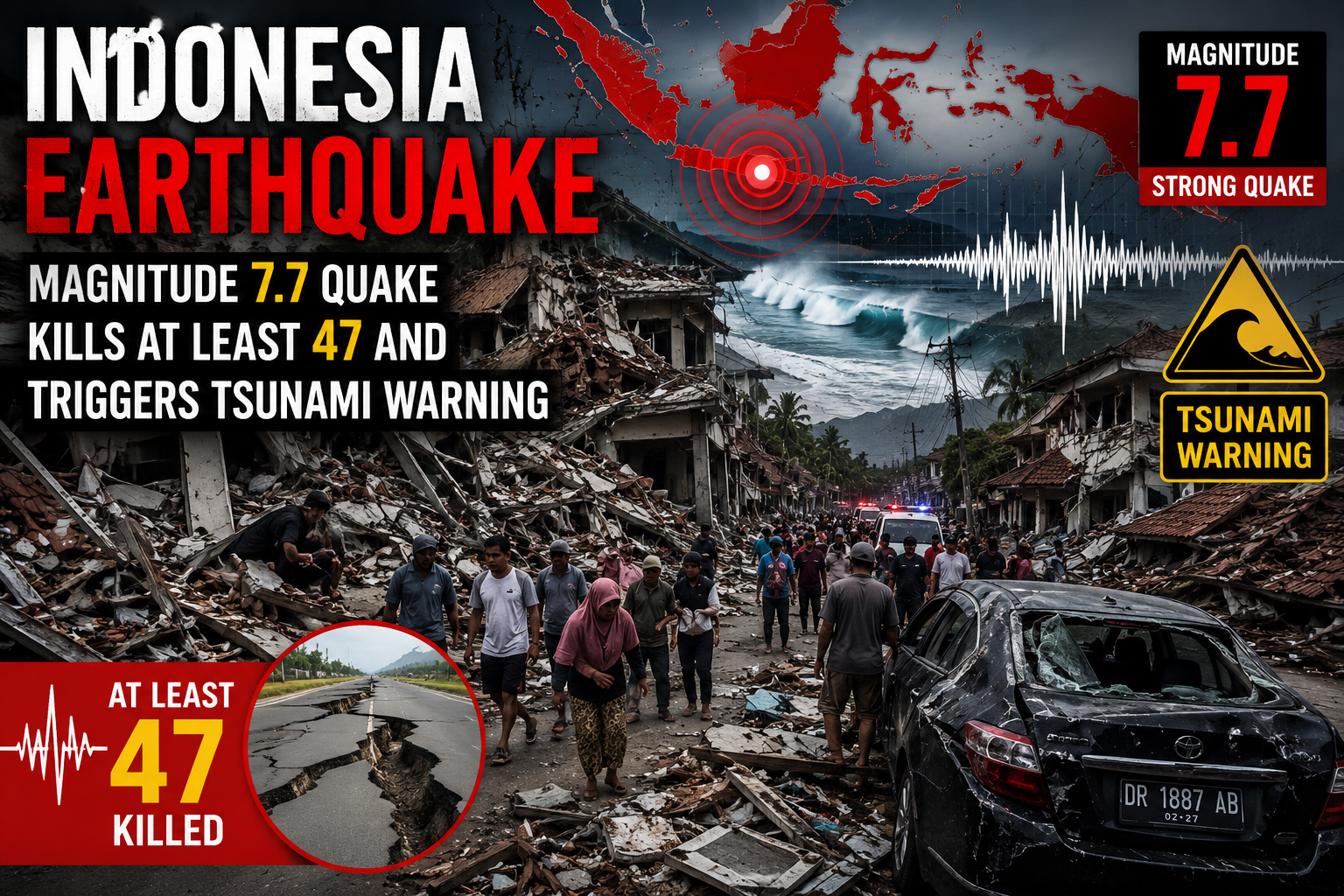
A powerful Indonesia earthquake measuring magnitude 7.7 struck the island of Flores early Saturday morning, killing at least 47 people and injuring several others, according to the country’s disaster management authorities. The strong earthquake caused widespread damage across several areas of East Nusa Tenggara, with hundreds of buildings damaged by the initial tremor and a series of powerful aftershocks.
The Indonesia earthquake struck shortly before 05:00 local time, when many residents were still asleep. The shallow depth of the earthquake, recorded at around 15 kilometres, contributed to the severity of the shaking and the destruction reported across affected communities.
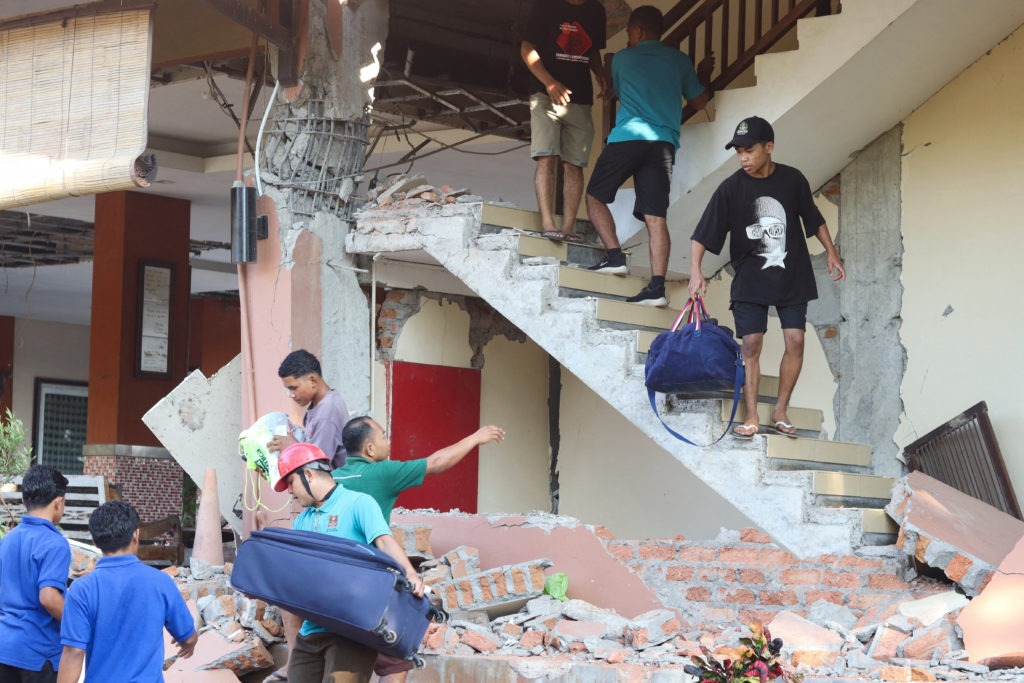
Rescue teams began searching damaged buildings as authorities worked to establish the full scale of the disaster. Officials warned that the death toll could change as emergency workers reached more affected locations and assessed damaged structures.
Powerful Earthquake Strikes Flores Before Dawn
The Indonesia earthquake occurred in the eastern part of the country, with Flores among the areas experiencing the strongest effects. Indonesia’s meteorology and geophysics agency reported that the earthquake occurred at a depth of approximately 15 kilometres.
The depth of an earthquake is an important factor in determining how strongly the shaking can be experienced at the surface. Shallow earthquakes generally have the potential to cause more severe damage because their energy travels a shorter distance before reaching buildings, roads and communities.
The timing of the earthquake also increased the danger. Because the main shock happened before dawn, many people were inside their homes and asleep when buildings began to shake violently.
According to the governor of East Nusa Tenggara, Emanuel Melkiades Laka Lena, some victims were killed while sleeping after rubble from collapsing structures fell on them.
Hundreds of Buildings Reported Damaged
The earthquake caused damage to hundreds of buildings across the affected region. Residential structures, public facilities and other buildings were affected by the intense shaking and subsequent aftershocks.
The scale of the damage created additional challenges for emergency responders. Damaged structures can remain unstable after a major earthquake, making rescue operations dangerous and slowing efforts to search for survivors.
The affected areas also experienced strong aftershocks, increasing anxiety among residents who were already dealing with damaged homes and infrastructure.
Death Toll Rises as Rescue Operation Begins
The official death toll reached at least 47 as authorities continued search and rescue operations. Manggarai was identified as one of the hardest-hit areas, with 24 fatalities reported there.
Other reported fatalities included:
- 17 deaths in East Manggarai
- Three deaths in Sikka
- At least one death in Ngada
- At least one death in Ende
- At least one death in West Manggarai
Authorities also reported several injuries, including people who suffered serious injuries as well as others with less severe injuries.
The number of casualties could change as rescue teams continue to inspect affected communities and damaged buildings.
Residents Remain Outside Their Homes
Many residents were reluctant to return home after the initial earthquake because of continuing aftershocks. In several communities, people remained outside or moved to safer locations while waiting for the ground to become stable.
Arnold Welianto, a resident of Talibura in Sikka, described being awakened by extremely strong shaking. He immediately went to check on his child before seeing residents fleeing toward higher ground.
His account reflected the fear experienced by many people in coastal communities following the earthquake and the subsequent tsunami warning.
Tsunami Warning Causes Mass Evacuations
A tsunami warning was issued following the Indonesia earthquake because authorities were concerned that the powerful undersea seismic activity could cause dangerous changes in sea levels.
The warning prompted thousands of people to move away from coastal areas. Some residents traveled inland or toward higher ground, while others evacuated on their own initiative.
The disaster management agency said around 2,000 people had evacuated or relocated themselves after the warning.
Video footage from the affected region showed people moving inland on motorcycles as residents attempted to reach safer areas.
Tsunami Warning Lifted After Three Hours
The tsunami warning remained in place for around three hours before being lifted after authorities detected no significant rise in sea levels.
Although the warning was eventually cancelled, the evacuation demonstrated the potential dangers associated with powerful earthquakes in coastal regions.
Residents were particularly alarmed after reports that the sea had receded. Some people interpreted the unusual movement of the water as a possible sign of tsunami activity and immediately moved away from the coastline.
Emergency officials urged people to remain cautious because strong aftershocks can continue following a major earthquake.
Port Damage Sends People Into the Sea
One of the most dramatic incidents occurred at the port in Maumere, where parts of the terminal building were damaged during the earthquake.
Video from the location showed large pieces of concrete breaking away from the structure and falling onto passengers who were waiting to board an inter-island ferry.
The situation became even more dangerous when a gangway leading to a ship collapsed. Some people were thrown into the sea as they tried to escape the falling debris and structural damage.
The incident highlighted how earthquakes can affect transportation infrastructure and create additional hazards for people attempting to evacuate.
Ports are particularly important in island communities such as those in eastern Indonesia because ferries provide essential connections between islands. Damage to port facilities can therefore affect both emergency evacuation and normal transportation.
Strong Aftershocks Add to the Fear
The main Indonesia earthquake was followed by dozens of aftershocks, including a powerful magnitude 6.1 tremor in the same eastern region.
Aftershocks can cause further damage to buildings that have already been weakened by the main earthquake. They can also make rescue operations more difficult because emergency workers have to operate in areas where structures may collapse without warning.
For residents, the continuing tremors created a strong fear of returning indoors.
Many people chose to sleep or remain outside because they were concerned that another powerful earthquake could strike.
A Lecturer Describes the Shaking
Yulian Juita Ekalia, a university lecturer from Ruteng, said she had never experienced an earthquake of this size.
She described the movement as feeling similar to being on a trampoline and said the experience was extremely frightening.
Rather than returning indoors, she moved her stove outside and prepared food there because she was afraid of additional tremors.
Her experience illustrates how an earthquake can change daily life immediately. Even after the main shaking stops, residents may remain too frightened to enter their homes or resume normal activities.
Another Earthquake Hits North Sumatra
The earthquake activity was not limited to Flores. Later on Saturday, another magnitude 6.4 earthquake was felt in North Sumatra, located in western Indonesia.
The North Sumatra earthquake was recorded at a considerably greater depth of approximately 163 kilometres.
Because it occurred much deeper underground than the Flores earthquake, its surface effects can differ significantly. Earthquake depth, distance from populated areas, building quality and local geology all influence how destructive an earthquake becomes.
The occurrence of another significant earthquake on the same day added to concerns across the country, although the two events occurred in different parts of Indonesia.
Why Indonesia Is Highly Vulnerable to Earthquakes
Indonesia is one of the world’s most earthquake-prone countries because it lies in a highly active tectonic region.
The country is located along the Pacific Ring of Fire, an area known for intense seismic and volcanic activity. Several tectonic plates interact around Indonesia, creating conditions where earthquakes occur frequently.
This geological setting means Indonesian communities must regularly prepare for earthquakes, volcanic eruptions, tsunamis and other natural hazards.
The Indonesia earthquake in Flores once again demonstrated the importance of emergency preparedness, strong construction standards and effective warning systems.
The Importance of Earthquake Preparedness
Major earthquakes can happen with little or no warning. Preparation before an earthquake can therefore make an important difference in reducing casualties.
Some essential safety measures include:
- Preparing an emergency supply kit
- Identifying safe evacuation routes
- Knowing where higher ground is located in coastal communities
- Securing heavy furniture and household equipment
- Practising earthquake evacuation procedures
- Following official warnings and instructions
- Avoiding damaged buildings after major shaking
- Keeping communication devices charged during emergencies
For communities located near coastlines, understanding tsunami evacuation routes is particularly important.
Search and Rescue Teams Face a Difficult Task
The rescue operation following the Indonesia earthquake is expected to remain challenging as authorities assess damaged communities.
Search teams must inspect collapsed and unstable structures while looking for people who may be trapped underneath rubble. Emergency workers also have to account for continuing aftershocks.
The situation can become more difficult when roads, bridges, communication systems and public facilities are damaged.
Local communities often play an important role during the first hours after an earthquake. Neighbours, volunteers and local emergency workers may begin searching for survivors before larger rescue teams reach isolated areas.
As authorities continue assessing the destruction, more information is expected about damaged infrastructure, missing people and the final number of casualties.
What Happens After a Major Earthquake?
The immediate response to a major earthquake focuses on saving lives and treating injured people. Once the initial rescue phase is completed, authorities normally turn their attention toward providing shelter, food, clean water and medical assistance to displaced residents.
People who cannot safely return to their homes may need temporary accommodation.
Authorities must also inspect buildings to determine which structures are safe and which need to be repaired or demolished.
The recovery process can take considerably longer than the initial emergency response. Families may lose homes, businesses may be forced to close and transportation networks can require extensive repairs.
The psychological impact can also continue long after the physical damage has been cleared.
Indonesia Earthquake Highlights the Need for Stronger Preparedness
The latest Indonesia earthquake has once again shown how quickly a natural disaster can disrupt communities.
From collapsing buildings and damaged ports to evacuations and widespread fear, the event affected thousands of people within minutes.
The shallow depth of the Flores earthquake made the shaking particularly dangerous, while the subsequent aftershocks increased the risk for residents and rescue workers.
The tsunami warning system also played an important role by prompting residents in coastal areas to move toward safer locations. Although the warning was lifted after no significant sea-level rise was detected, the evacuation demonstrated why communities need to take official warnings seriously.
Conclusion
The powerful Indonesia earthquake that struck Flores has left at least 47 people dead and caused significant damage across East Nusa Tenggara. Hundreds of buildings were affected, several people were injured and thousands of residents evacuated or relocated following a tsunami warning.
The earthquake’s shallow depth, strong aftershocks and impact on coastal infrastructure created a complex emergency for local authorities and residents. The damage at Maumere port and the collapse of a ferry gangway showed the dangers that can emerge when critical infrastructure is struck by a major earthquake.
As search and rescue operations continue, authorities will work to determine the full extent of the destruction and provide assistance to affected communities. The disaster also serves as a reminder of Indonesia’s exposure to powerful earthquakes and the importance of preparedness, resilient infrastructure, effective emergency warnings and community awareness.
For people living in earthquake-prone regions, preparation is not simply a precaution. It can be a critical factor in protecting lives when the next major earthquake occurs.

Comments
Leave a Comment